RevenueCat Pricing for a Lovable App
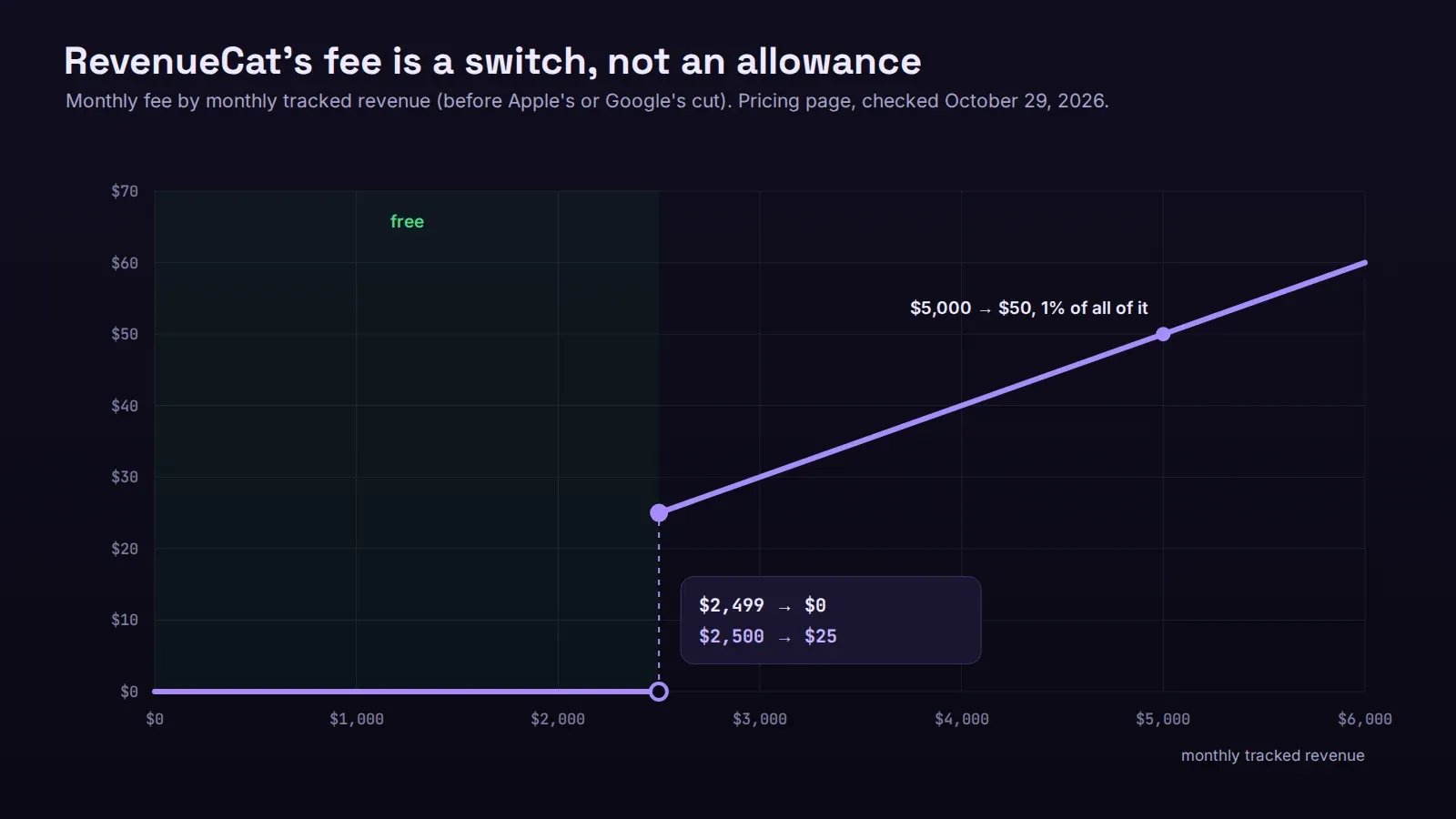
RevenueCat costs nothing until your app tracks $2,500 of revenue in a month. From that month on it charges 1% of everything it tracked, not 1% of the part above $2,500, and it measures that revenue before Apple or Google take their cut. That’s from RevenueCat’s pricing page, checked October 29, 2026, and those three details are the whole story.
If your Lovable app sells subscriptions or credits inside the iPhone app, you’re going to meet RevenueCat. Apple wants digital goods sold through in-app purchase (we covered when Stripe is still allowed), and RevenueCat is the usual way to know who’s paying across Apple, Google and the web without writing two webhook pipelines yourself. So it’s worth knowing what it really costs before you wire it in.
What “monthly tracked revenue” counts
RevenueCat’s own definition: MTR is “the amount of revenue tracked by RevenueCat (in USD, before the platform cut) during a one-month billing period. This includes paid subscriptions, renewals, and one-time purchases.”
Two things fall out of that.
It’s gross. A $9.99 subscription counts as $9.99 even though Apple pays you $8.49 of it on the Small Business Program. RevenueCat says this is deliberate: they don’t want to be paid less when they help you move people to cheaper platforms, Stripe included.
And it’s everything you route through it. If you connect your Stripe web subscriptions so the app knows about them too, those dollars are tracked revenue as well. Handy for one “is this user Pro?” answer. Not free.
The $2,500 cliff
Here’s the line from their FAQ that people skim past: “Once you reach $2.5K MTR, you’ll be charged 1%. For $2.5K, we’ll charge you $25. No charges apply on months when you don’t hit the $2.5K threshold.”
So it’s not a free allowance with 1% on top. It’s a switch. A month at $2,499 costs $0. A month at $2,500 costs $25.
Honestly, I don’t think the cliff matters much. $25 when you’re making $2,500 a month is fine. But it does mean a month that hovers right around the line can cost you $25 for a few extra dollars of sales, so don’t be surprised when it shows up on the invoice.
What it costs at real numbers
Assume a subscription app on Apple’s Small Business Program (15% instead of 30%, for developers under $1 million a year, see our post on the program). Everything below is per month.
| Tracked revenue | RevenueCat | Apple’s 15% | You keep | RevenueCat as a share of what you keep |
|---|---|---|---|---|
| $1,000 | $0 | $150 | $850 | 0% |
| $2,499 | $0 | $374.85 | $2,124.15 | 0% |
| $2,500 | $25 | $375 | $2,100 | 1.19% |
| $10,000 | $100 | $1,500 | $8,400 | 1.19% |
| $50,000 | $500 | $7,500 | $42,000 | 1.19% |
Because the fee is on gross revenue, it’s a bit more than 1% of what actually lands in your bank: about 1.19% at the 15% rate, about 1.45% if you’re paying Apple 30%.
Everything is included on that plan: paywalls you can change without an app update, A/B experiments, charts, webhooks, integrations. Enterprise is custom pricing for big apps. There’s also a separate “Growth Tools” option where you keep your own purchase code and pay 1% only on conversions that come through their paywalls or web funnels.
Wiring it into a Lovable app
For a Lovable app shipped with Capacitor, the plugin is @revenuecat/purchases-capacitor. You configure it once at startup with the platform’s public API key (iOS and Android have separate ones) and, this is the bit people skip, the Supabase user id as appUserID. If you let RevenueCat invent anonymous ids, your webhooks arrive with ids your database has never heard of, and someone ends up writing a matching script at midnight.
Then don’t make your app ask the SDK “is this user Pro?” on every screen. Point a RevenueCat webhook at a Supabase edge function, write the entitlement and its expiry into a column on the user’s profile, and let your RLS policies read that column. The web version of your app, which never loads the SDK, gets the same answer for free.
Products still have to exist in App Store Connect and Google Play Console first, with tax and banking done, and Apple reviews each new subscription together with an app build. RevenueCat can’t skip any of that.
Should you build it yourself instead?
You can. Apple’s App Store Server Notifications and Google’s real-time developer notifications both hit a webhook you control, and a Supabase edge function can keep the same entitlement column up to date. No percentage.
I wouldn’t, below a fairly large number. Renewals, grace periods, billing retry, refunds, upgrades between tiers, family sharing, two stores with two different payload formats: every one of those is a bug you’ll find in production. Under $2,500 a month RevenueCat is free, which makes the decision for you. At $10,000 it’s $100 a month, which is less than an afternoon of a developer’s time spent on the first refund bug. Somewhere well past that, writing your own starts to make sense, and by then you’ll have the revenue to pay for it.
The one thing I don’t love: your source of truth for “who paid” now lives at a third company. The webhook-into-Supabase pattern above is how we keep that from mattering day to day.
If your Lovable app is about to go into the App Store with subscriptions and you’d rather not set up products, the SDK and webhooks yourself, that’s part of taking a Lovable app to the App Store with us. Or ask us anything first.